Leveraging Artificial Intelligence for Smart Policing and Modern Crime Investigation in Africa
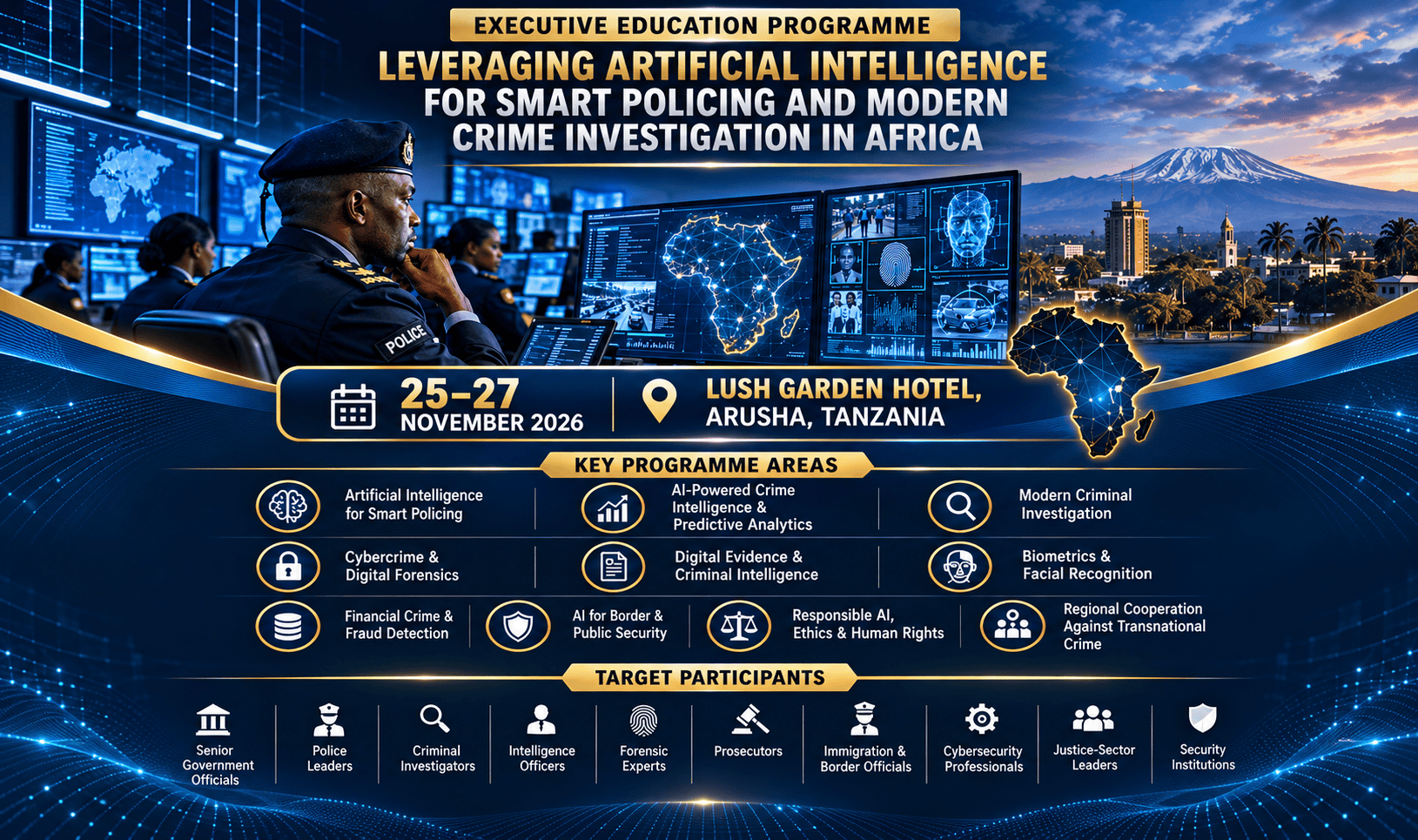
Join the Executive Education Programme on Leveraging Artificial Intelligence for Smart Policing and Modern Crime Investigation in Africa, taking place from 25–27 November 2026 at Lush Garden Hotel, Arusha, Tanzania. Explore AI-powered crime intelligence, predictive analytics, digital forensics, cybersecurity, smart policing technologies, and responsible AI applications to strengthen law enforcement and public safety across Africa.
Leveraging Artificial Intelligence for Smart Policing and Modern Crime Investigation in Africa
Executive Education Programme | 25–27 November 2026 | Arusha, Tanzania
About the Programme
Artificial Intelligence (AI) is rapidly transforming the way governments, law enforcement agencies, and security institutions prevent crime, conduct investigations, analyze intelligence, and protect communities.
The Executive Education Programme on Leveraging Artificial Intelligence for Smart Policing and Modern Crime Investigation in Africa, scheduled for 25–27 November 2026 at Lush Garden Hotel, Arusha, Tanzania, will explore how emerging AI technologies can enhance modern policing, criminal investigations, intelligence operations, and public security.
The programme focuses on equipping senior government officials, police leaders, criminal investigators, intelligence officers, and security professionals with knowledge of innovative AI-powered solutions and their practical applications in law enforcement.
With the increasing complexity of cybercrime, financial fraud, organized crime, and cross-border security threats, adopting intelligent technologies has become an important consideration for modern security institutions.
This executive education programme provides an opportunity to examine technological advancements, strengthen professional knowledge, and encourage responsible digital transformation in Africa's law enforcement and justice sectors.
Key Programme Areas
1. Artificial Intelligence for Smart Policing
Explore how AI-powered systems can enhance policing operations, improve decision-making, and strengthen proactive approaches to crime prevention and public safety.
2. AI-Powered Crime Intelligence and Predictive Analytics
Understand how artificial intelligence, machine learning, and data analytics can support crime pattern identification, intelligence analysis, and evidence-based resource planning.
3. Modern Criminal Investigation
Examine emerging digital tools and investigative technologies that can support complex criminal investigations, intelligence gathering, and evidence analysis.
4. Cybercrime and Digital Forensics
Explore modern approaches to detecting, investigating, and responding to cybercrime, including digital evidence collection, forensic analysis, and emerging cybersecurity threats.
5. Digital Evidence and Criminal Intelligence
Understand the role of digital evidence management, information analysis, and technology-enabled intelligence systems in supporting effective criminal investigations.
6. Biometrics and Facial Recognition
Examine the applications, limitations, and safeguards associated with biometric identification, facial recognition technologies, and AI-assisted identity verification.
7. Financial Crime and Fraud Detection
Explore how AI-powered analytics can assist in identifying suspicious financial activities, detecting fraud patterns, and supporting investigations into financial and economic crimes.
8. AI for Border and Public Security
Discover how intelligent systems can support immigration management, border monitoring, threat assessment, and coordinated public security operations.
9. Responsible AI, Ethics and Human Rights
Examine the ethical, legal, and human rights considerations surrounding the adoption of AI in policing, including privacy, accountability, transparency, fairness, and responsible data use.
10. Regional Cooperation Against Transnational Crime
Explore the importance of regional collaboration, information sharing, and technology-driven cooperation in addressing cross-border crime and emerging security challenges across Africa.
Programme Objectives
The programme aims to:
Strengthen awareness of AI applications in modern policing and criminal investigations.
Enhance understanding of emerging technologies used in crime intelligence and public safety.
Promote innovation and digital transformation within law enforcement institutions.
Improve knowledge of cybersecurity, digital forensics, and technology-assisted investigations.
Encourage the responsible and ethical adoption of AI while protecting human rights.
Support collaboration and knowledge exchange among security institutions and relevant stakeholders.
Explore opportunities for using AI to address emerging security challenges in Africa.
Target Participants
The programme is designed for senior professionals and decision-makers, including:
Senior Government Officials
Police Leaders
Criminal Investigators
Intelligence Officers
Forensic Experts
Prosecutors
Immigration and Border Officials
Cybersecurity Professionals
Justice-Sector Leaders
Security Institutions
Why This Programme Matters
As criminal activities become increasingly sophisticated, traditional approaches to law enforcement must evolve to address emerging technological and security challenges.
Artificial Intelligence presents opportunities to strengthen crime detection, accelerate intelligence analysis, support investigations, and improve institutional efficiency.
However, integrating AI into law enforcement requires appropriate technical capabilities, sound governance frameworks, data protection safeguards, and responsible implementation.
This executive education programme emphasizes the importance of understanding both the opportunities and challenges associated with AI-powered policing.
It seeks to contribute to the development of informed, innovative, and accountable security institutions capable of responding effectively to modern crime and public safety challenges.
Event Details
Event Title: Leveraging Artificial Intelligence for Smart Policing and Modern Crime Investigation in Africa
Programme Type: Executive Education Programme
Dates: 25–27 November 2026
Venue: Lush Garden Hotel
Location: Arusha, Tanzania
Advancing the Future of Smart Policing in Africa
The future of law enforcement increasingly depends on the effective integration of technology, professional expertise, institutional collaboration, and responsible innovation.
By exploring AI-powered crime intelligence, digital investigation technologies, cybersecurity, and ethical governance, this programme aims to promote forward-thinking approaches to policing and public security across Africa.
Join the conversation on shaping a safer, smarter, and more technologically advanced future for policing and criminal investigation in Africa.